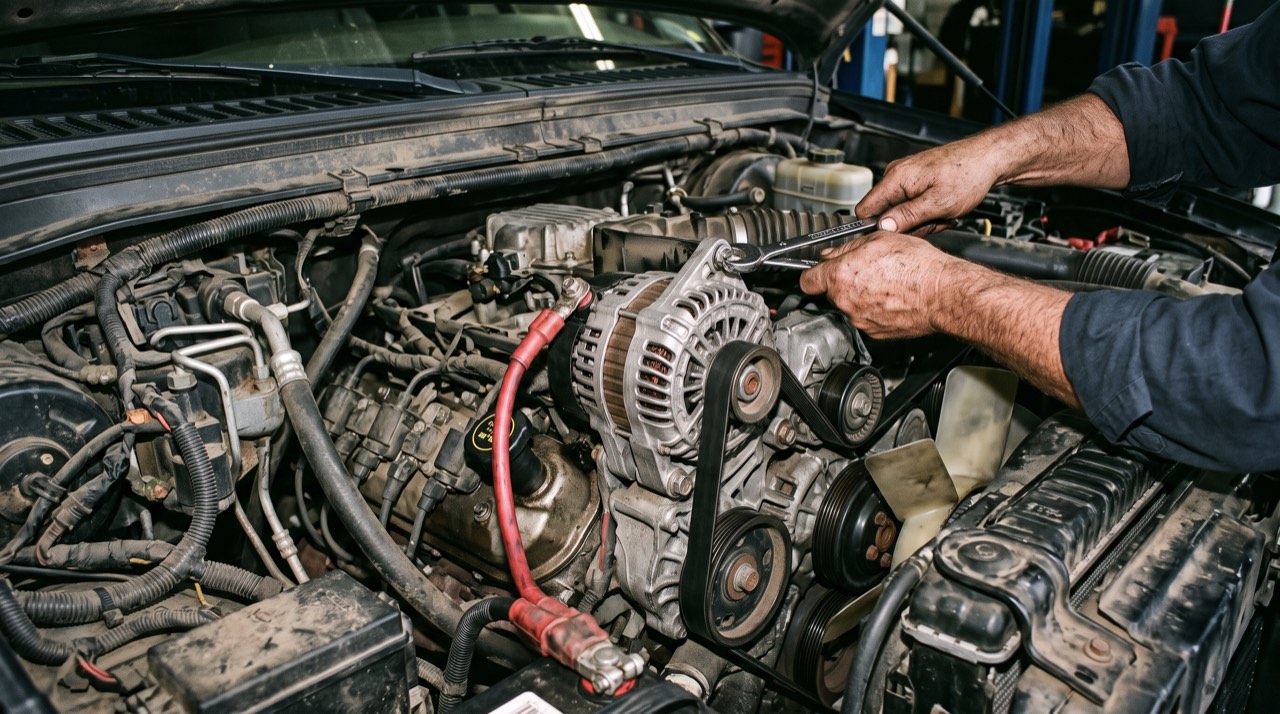
Sizing an Alternator for a Loud-but-Daily Audio Build
Alternators & Electrical · 7 min read
Adding a kilowatt of audio without upgrading the alternator is the most common — and most expensive — mistake in car audio. The amps work, the music sounds good, but your headlights flicker on bass hits, your battery dies in six months, and your factory alternator burns out in a year. The fix isn't another battery. It's a properly sized alternator.
Why 'rated amps' lies a little
Most factory and aftermarket alternators are rated at peak RPM — typically 6,000+ alternator RPM, which is your engine spinning at highway speed. At idle (700–900 engine RPM), output drops by 30–50%. A factory 160A alternator might only put out 90A while you're sitting at a stoplight. If your audio system pulls 150A at full chat, you're running on battery alone every time the music gets loud and the engine isn't revving.
High-output aftermarket alternators (JS-Alternators and others) use larger stators, denser windings, and sometimes hairpin construction to deliver much more current across the entire RPM range — especially at idle, which is where it counts.
The current-budget approach
Add up your loads honestly. A typical 1500W RMS system at 80% efficiency pulls about 130A. Add vehicle baseline (30–40A for ignition, ECU, fuel pump, lights, climate), accessories (10–30A for heated seats, factory amp, cargo loads), and you're at 175–200A continuous. Multiply by a usage-profile factor:
- • Daily driver — 1.2× headroom (occasional max-volume bursts)
- • Show / demo — 1.5× (long stretches at high output)
- • Competition — 2.0× (back-to-back demos, hours at full duty)
- • Overlanding — 1.4× (idle-heavy with fridge + lights + winch occasionally)
A daily-driven 1500W RMS build needs roughly 200A × 1.2 = 240A. A 320A alternator gives you margin and won't cook itself sitting in traffic. A competition build at 3000W needs 250A × 2.0 = 500A — that's where dual alternators or 370A+ hairpin units come in.
The "do I need a second battery" question
A second battery doesn't solve an undersized alternator — it just delays the voltage drop. The alternator has to refill both batteries plus run all loads. If your alternator can't keep up, two batteries get drained twice as slowly but still get drained. Size the alternator first, then add a second battery for transient buffering and engine-off listening.
JS-Alternators builds custom high-output alternators for car audio, offroad, marine, and motorsport. Hand-built, dyno-tested at idle and full RPM, lifetime warranty. The Alternator Sizing calculator gives you a recommended output amp rating and links you straight to their catalog.
Gear for this build
In stock at our partner shops — real prices, shipped from people who run this stuff.

JS Alternators
JS Alternators High-Output Alternator
250A–400A+ hand-built in the USA. Find the fit for your year/make/model.
Shop →

Sundown Audio
Sundown SA150-975L Super-Cap Battery
What a capacitor pretends to do — real stored energy for voltage sag.
Shop →

Sundown Audio
Sundown Full Tilt 50' 1/0 AWG Cable
50 ft of 1/0 AWG power/ground — the gauge most big-three upgrades call for.
Shop →

Stealth Energy
American Bass Stealth ST-750 75Ah AGM
75Ah AGM — deep reserve for high-draw audio and dual-battery setups.
Shop →
JS Ultimate Sounds and JS Alternators are run by the ShowUp team — buying there supports the site. Prices as listed at the shop.