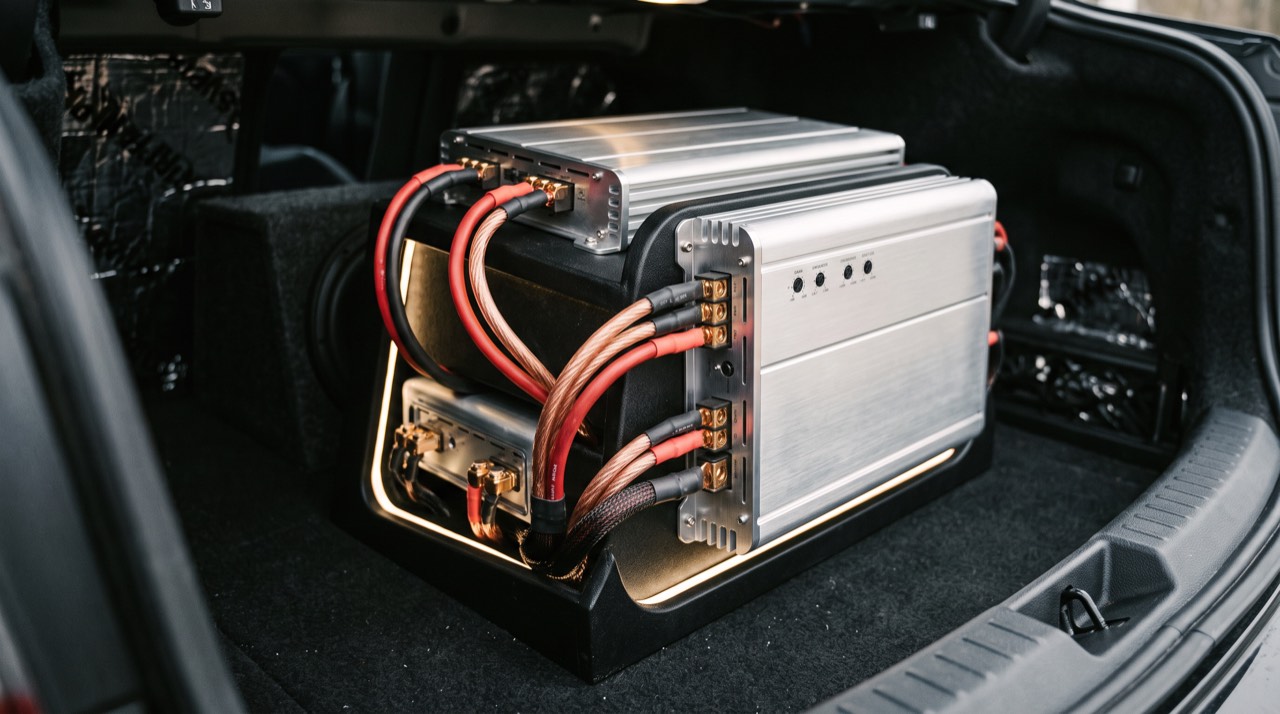
Wattage, RMS, and the Numbers That Actually Matter
Car Audio Basics · 5 min read
Walk into any big-box retailer and you'll see amps labeled 1500W, 2000W, even 3000W — usually printed in a font that's hard to miss. Those numbers are almost always peak power, measured for milliseconds under conditions nobody actually drives in. The number that matters for your build, your wiring, and the speakers downstream is RMS.
Peak vs. RMS — the short version
Peak power is the maximum an amplifier can produce for a fraction of a second before its protection circuits clamp down. RMS (Root Mean Square) is what it can sustain continuously without clipping or overheating. A reputable amp will publish both — typically at 4Ω, 2Ω, and sometimes 1Ω. If you only see 'max power' on the box, you're looking at marketing copy, not engineering data.
The factor between peak and RMS varies, but 3–4× is common in budget gear and ~1.5–2× in serious gear. So a $200 amp advertised as '1500W max' is realistically a 400–500W RMS amp. That's fine — just plan around the real number.
Why it matters for wiring
Wire size, fuse size, and amp current draw are all based on RMS, not peak. A 1000W RMS amp running near full output draws roughly 1000 ÷ (12V × 0.8 efficiency) ≈ 104 amps of current. That's a 4 AWG OFC cable for a 15-foot run if you want to keep voltage drop under 2%. Wire it for peak and you'll undersize the gauge by two steps — it'll work, but it'll run hot and your amp will see 12.6V at idle instead of 14.1V at the source.
Why it matters for speakers
- • Match speaker RMS to amp RMS within ±25% for safe headroom
- • Sub RMS too low + amp pushed hard → blown voice coils
- • Sub RMS too high + amp underpowered → flabby, distorted output
- • Tweeters are the most fragile — a crossover keeps them safe
The Amplifier Power calculator gives you output voltage, current draw, recommended wire gauge, and fuse size in one shot — all driven by RMS, not peak.
How to read a spec sheet honestly
Look for these CEA-2006 compliant numbers: RMS power at 4Ω with 1% THD+N at 14.4V (or ≤14V). Anything quoted at 14.4V with <0.5% THD and rated against multiple impedances is trustworthy. Numbers without conditions — just 'peak' or 'max' — are advertising. Trust the conservative spec; build around it, and you'll never blow a speaker or melt a fuse on the way home from the install.
Gear for this build
In stock at our partner shops — real prices, shipped from people who run this stuff.

Sundown Audio
Sundown Full Tilt 50' 1/0 AWG Cable
50 ft of 1/0 AWG power/ground — the gauge most big-three upgrades call for.
Shop →

Orion Car Audio
Orion XTRPRO2K Monoblock
2000W max Class D mono — stable to 1Ω for a big sub stage.
Shop →

Orion Car Audio
Orion CEA1600.1D 1600W RMS Mono
1600W RMS Cobalt Elite monoblock — real power per dollar.
Shop →

Sundown Audio
Sundown Full Tilt 50' 4 AWG OFC Cable
True OFC 4 AWG — for runs where CCA voltage drop won’t cut it.
Shop →
JS Ultimate Sounds and JS Alternators are run by the ShowUp team — buying there supports the site. Prices as listed at the shop.